
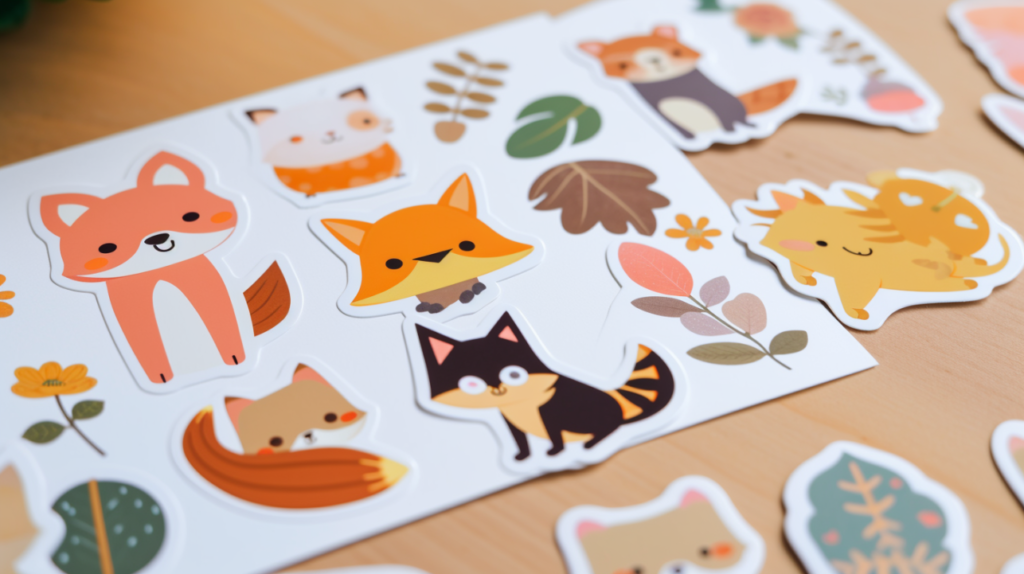
In brief: The Intriguing Psychology of Sticker Collecting: Exploring Identity, Nostalgia, and Personal Expression begins with a simple idea: a sticker can matter because of what its owner associates with it. A collection may preserve memories, represent interests, signal affiliation, or provide raw material for visual expression. Those meanings vary, however. Not every sticker reveals a deep trait, and research about possessions generally should not be mistaken for proof that sticker collecting produces a particular psychological benefit.
A sticker is physically modest: printed material, adhesive and backing, sometimes with a coating or special finish. Yet it can recall a childhood reward chart, a favorite band, a memorable trip or the artist who handed it over at a convention. The psychology becomes clearer when the collection is viewed not simply as accumulated material but as a set of objects selected, preserved and arranged by a particular person.
The psychology of sticker collecting starts with meaning
Research on possessions offers a useful foundation. A psychological review summarized by PubMed’s overview of objects and self-identity describes objects as carriers of personal and social meaning. Possessions can relate to self-identity, significant life events and signals of group membership. That does not mean every object defines its owner, but it helps explain how a commonplace printed item can become personally important.
Stickers are especially suited to collecting because they combine imagery, text and physical context in a compact form. Two stickers showing the same subject may carry different meanings if one was found in an old school notebook and the other was bought last week. The image matters, but so do its origin, age, condition and connection to a person or event.
It is also useful to separate several activities that are often grouped together as “collecting.” One person may enjoy finding stickers but rarely display them. Another may preserve unopened sheets. Someone else may trade duplicates, decorate daily objects or reorganize an album repeatedly. Acquiring, preserving, trading, arranging and displaying can each satisfy a different preference.
How a collection may reflect identity
Repeated choices create patterns. A collector may favor wildlife illustrations, local businesses, skate graphics, political causes, typography, vintage packaging, sports teams or a specific color palette. Over time, the collection can become a visual index of what has repeatedly attracted that person’s attention.
That pattern may reflect identity in several ways:
- Interests: subjects such as music, games, travel, plants or transportation can dominate a collection.
- Aesthetic preferences: restrained monochrome designs and dense holographic graphics create very different visual worlds, even when their subject matter overlaps.
- Values: some collectors deliberately keep stickers connected to causes, communities or organizations they support.
- Roles and milestones: stickers from schools, workplaces, clubs, exhibitions and events can represent periods of life.
- Creative identity: collecting artwork from independent illustrators may reflect an interest in particular drawing styles, print effects or design movements.
These are possible interpretations rather than a personality test. Someone may keep an animal sticker because it represents a favorite species, because a friend gave it to them or simply because its die-cut shape is satisfying. A collection becomes understandable through the owner’s associations, not through a universal decoding system.
Affiliation without a lengthy explanation
A sticker can function as a compact social signal. A band logo on a laptop, a club emblem on a case or an artist’s design on a notebook can make an interest visible to other people. That visibility may start conversations and help enthusiasts recognize a shared reference.
Trading adds another social layer. In a fandom, school, conference or art community, exchanging stickers can mark participation and create a physical reminder of an interaction. The sense of affiliation comes from the surrounding relationship and context; owning the printed object alone does not guarantee belonging.
Private collections and public displays communicate differently
Where stickers are kept changes how they work. A private album primarily serves its owner, while a public display also communicates with an audience. Neither approach is more authentic; each gives the collector different control over preservation, arrangement and visibility.
| Collection approach | What it emphasizes | Practical tradeoff |
|---|---|---|
| Album, binder or archive box | Preservation, organization and private browsing | Stickers remain protected but are less visible in daily life |
| Journal or scrapbook | Memory, sequence and written context | The page preserves a narrative, although rearrangement may be difficult |
| Laptop, bottle or case | Everyday display and social signaling | The sticker becomes visible but may wear with handling or outlast the object |
| Framed sheet or removable display | Composition and visual impact | Offers controlled presentation but requires planning around spacing and attachment |
| Trading collection | Exchange, completion and community participation | Duplicates can be useful, while condition and organization become more important |
Placement itself can be expressive. A tightly aligned grid suggests a different sensibility from a layered sticker-bomb composition. Leaving the backing intact preserves future options; applying the sticker turns a collectible into part of another object. Collectors who want alternatives to a conventional album can also explore creative uses for stickers beyond basic decoration.
Why old stickers can evoke nostalgia
A sticker can become a cue for autobiographical memory because it was present during a meaningful experience. An old travel sticker may bring back the people on the trip, the weather that day or the bag on which it was originally placed. A faded school sticker may recall a teacher, classroom or stage of childhood rather than merely the design printed on it.
An interdisciplinary review of possessions and memories found that attachment to meaningful objects can involve preserving, embodying, showcasing and recollecting memories. That framework fits many sticker collections: an album can preserve an object, give a memory physical form, make it available for display and help prompt recollection.
Nostalgia can also connect different periods of a person’s life. In a six-experiment study, nostalgia fostered a sense of self-continuity partly through greater social connectedness; the study assessed subjective vitality as its well-being outcome. This supports a broader relationship among nostalgia, connection and continuity, but it was not a study of sticker collectors specifically.
The memory does not need to concern a major event. Promotional stickers from a closed shop, labels saved from childhood stationery or graphics from an old hobby can evoke an ordinary period that now feels distant. Their value may lie less in rarity than in their ability to make that period feel accessible.
Curation turns accumulation into personal expression
Creative expression happens after acquisition as well as during it. Selecting which stickers belong together, deciding whether to preserve or apply them and controlling color, scale and spacing all shape the collection’s visual voice.
A collector can approach curation in several practical ways:
- Build pages around a subject, place, person or period rather than forcing every sticker into one master display.
- Record where and when a meaningful sticker was acquired, especially when its story is not obvious from the artwork.
- Use duplicate or less sentimental stickers to test a layout before committing rare or irreplaceable pieces.
- Photograph stickers applied to objects that will eventually be replaced, recycled or discarded.
- Separate archival priorities from display priorities so the most meaningful pieces are not exposed to unnecessary handling.
- Create original artwork or commission custom stickers when the collection needs a symbol, character or visual theme that does not already exist.
Collectors designing their own pieces should also distinguish inspiration from permission to reproduce someone else’s artwork. The practical overview of copyright and sticker printing is a useful next step before turning collected imagery, characters or logos into a new print file.
No two collections need to mean the same thing
One person may seek a complete set, another may collect only stickers received as gifts, and a third may care mainly about printing techniques such as metallic effects, clear substrates or unusual cut shapes. Some people enjoy orderly classification; others prefer the surprise of an eclectic page. Motivations can also change. A childhood collection built around acquisition may later become valued primarily as a memory archive.
This variation is why broad psychological research should be applied carefully. Evidence about meaningful possessions and nostalgia provides plausible ways to understand sticker collecting, but it does not establish one sticker-specific model or prove that the hobby increases self-esteem, belonging or mental health. The most reliable explanation starts with what the collector actually does and what particular objects mean to them.
Keeping the hobby enjoyable and manageable
Ordinary enthusiasm, duplicate purchases and a crowded album are not diagnoses. A practical boundary is whether collecting still fits the person’s space, budget and daily responsibilities. It may be time to pause and reassess if buying repeatedly exceeds an established budget, storage creates substantial disruption, or the prospect of organizing or discarding items causes persistent distress.
Simple limits can preserve the enjoyable part of the hobby: choose a monthly budget, define a storage area, photograph items before letting them go, trade duplicates and narrow new purchases to a theme. If acquisition or difficulty discarding seriously interferes with daily life, discussing it with a qualified mental-health professional is more appropriate than trying to label the behavior from an article.
A collection is a visual record of attention
Sticker collections can be meaningful because they record what a person noticed, enjoyed, supported or wanted to remember. Identity shapes selection, nostalgia can deepen attachment, and curation turns separate printed pieces into a personal composition. The next useful step is not to interpret every sticker. Instead, choose one page or group and note where each piece came from, why it was kept and whether it belongs in an archive or a display. The resulting stories will usually explain the collection better than the images alone.
