
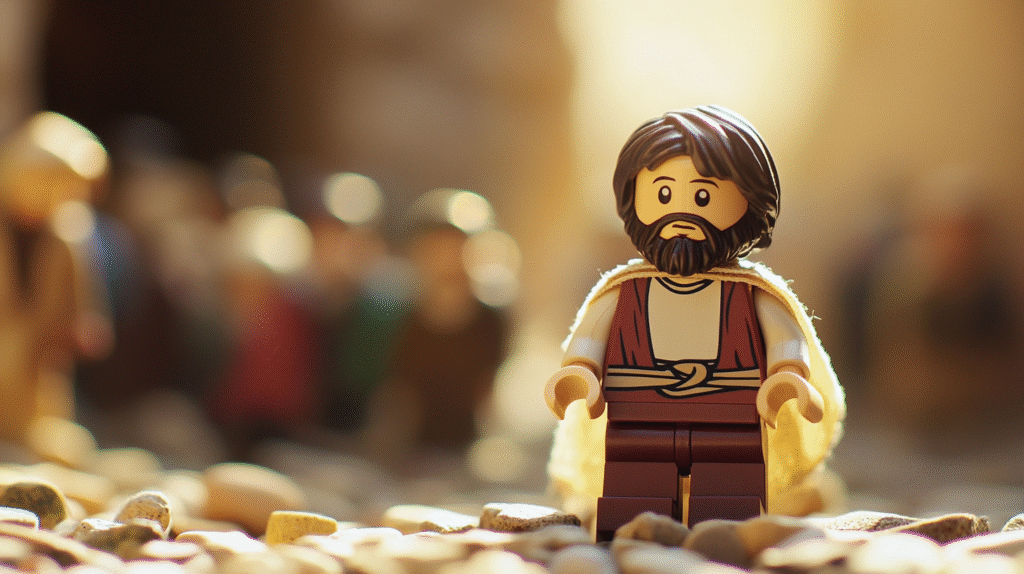
We tend to think of toys as things that keep kids busy while adults get stuff done. We forget they’re doing something serious while they play. Especially when they build something. Especially when they start telling stories.
Give a kid a handful of minifigs and a few random bricks, and they’ll do what humans have always done—they’ll tell a story. Maybe it’s funny. Maybe it’s weird. Maybe it’s total nonsense. But something is happening there. A world is forming. And when you step back, it starts to look like something familiar.
It looks like us. It looks like the way we figure things out.
Why Stories Matter
We live by stories. We tell them to explain things we can’t see, or make sense of things that don’t make sense at all. Sometimes they’re personal—“This happened to me and here’s what I learned.” Sometimes they’re collective—“This is what we believe. This is who we are.”
Parables, myths, memories, comics, movies, prayers. It’s all storytelling. Different languages, same function.
And play is storytelling, too. Especially imaginative play. Especially when it involves characters that walk and talk and wear capes or carry books or hold tiny swords.
You can laugh at it—and honestly, you should sometimes—but that doesn’t mean it isn’t serious underneath.
The Theology of Tiny People
Minifigs are basically blank slates. They’ve got enough detail to suggest a role—chef, knight, wizard, barista—but they’re vague enough to be anyone. Which makes them perfect for creating stories.
And that’s what kids (and sometimes adults) do. They cast these little characters into stories about friendship, justice, sacrifice, love, loss. The language is simple, the set is plastic, but the themes go way deeper than we give credit for.
This might sound like a stretch. It’s not. A child who builds a village and has the villagers rally to stop a tyrant is telling a story about community and courage. A kid who puts a figure on a mountain to pray is, in their own way, exploring faith.
It might be chaotic. It might not follow any clear arc. But the impulse is there: tell a story to understand something.
Isn’t that what parables do?
Play Is the First Draft of Belief
A lot of faith learning starts in childhood. We hear stories about creation, exile, miracles, forgiveness. We imagine the people involved. We try to figure out what it means.
That doesn’t stop just because we grow up. We just trade Sunday school flannel boards for more polished tools. But the root is the same: storytelling helps us explore belief.
The difference with toys, especially figures, is that they let the child step into the story in a hands-on way. They move the characters. They choose what happens next. They insert themselves.
It’s a way of rehearsing what faith could look like.
What happens when the healer refuses to give up on someone? What if the leader fails? What does justice mean in this tiny made-up town?
That’s not fluff. That’s theology in motion.
Stories with Limits—and Freedom
Here’s the thing about building stories out of plastic toys: the pieces limit you. You only have so many heads, torsos, and props. You only have a few bricks in one color. So you make do.
This is actually a gift.
Limits force creativity. They push you to imagine new combinations. Maybe the pirate is also the teacher. Maybe the robot is the prophet. Maybe the princess doesn’t need saving because she’s been building the escape tunnel herself.
These creative decisions echo real-world questions. What makes a person a leader? What happens when we don’t follow the script? What do we do when the pieces we have don’t match the roles we’ve seen?
It’s not just play. It’s rehearsal. It’s experimenting with the ideas we carry into adulthood.
The Value of Repetition
Watch a child play with minifigs over time and you’ll notice something: the same themes keep showing up. Someone is left out. Someone is in danger. Someone learns something new. They return to these ideas again and again.
That’s not a flaw. That’s how learning works.
We repeat the stories that help us. We retell them until they settle in our bones. And that applies to both scripture and play.
The Prodigal Son isn’t a one-time read. Neither is the story about the sheep, or the mustard seed, or the good neighbor. We return to them, each time a little older, each time maybe understanding something new.
Kids do the same thing in play. They’re not bored. They’re working it out.
Where Imagination Meets Practice
What’s surprising is how often play leads to action. A kid who plays out a rescue mission might later ask what to do if they see someone hurt. A child who builds a food-sharing program in their minifig village might get curious about food drives in real life.
Play is low-stakes, but the thoughts it sparks aren’t always.
It’s not about pretending to care. It’s about learning how to care. That starts in small, often silly ways. But it grows.
And it’s worth paying attention to.
The Role of Tools
Not every kid has access to the same materials. That’s why platforms that offer unusual or diverse minifigs can make a difference. Most toy stores carry the same police, firefighters, ninjas. And those are fine. But when you give a kid access to, say, a climate scientist or a medieval healer or a robot monk, you’re expanding the range of stories they can tell.
One place that does this well is Minifig.biz. They sell custom minifigs in all sorts of imaginative combinations—some serious, some funny, some just totally weird. But what they all do is invite story. And sometimes, that’s all a kid needs.
You don’t need to make a big thing out of it. Just give them something new to work with and see where it goes.
Play Is Human
We grow up and forget how we got here. We forget that a lot of our values, our empathy, our beliefs—they started in play. In make-believe. In putting characters into situations and seeing what they’d do.
That’s still true, even if now our characters wear suits or stand behind pulpits or write articles like this one.
The stories we tell shape how we live. That’s not just a saying. That’s a pattern.
And the earlier someone gets to practice telling stories with purpose, with meaning, with room for grace and surprise—the better.
So What’s the Point?
If you’ve read this far, maybe you’re wondering: is this really about toys?
Yeah, kind of. But not just that.
It’s about how even the smallest acts of creativity can echo something deeper. It’s about giving kids the tools to think, feel, imagine, and wonder. And maybe giving ourselves permission to do that, too.
You don’t have to believe that minifigs are sacred objects. But you might find something sacred in what they help create. A moment of peace. A burst of empathy. A small story that lingers.
And sometimes, that’s enough.
