Key Takeaway
Introduction to Sticker Copyright Infringement
Stickers and decals have become an integral part of our daily lives. They are used to decorate our laptops, water bottles, and even our cars! But have you ever stopped to think about the artwork you are using on your stickers and decals? It might surprise you, but using someone else’s artwork without their permission is not okay.
It’s a violation of the owner’s intellectual property rights and can result in serious consequences, including a hefty fine and legal action. So, what should you do if you want to use someone else’s artwork on your stickers and decals? The answer is simple: ask for permission!
Finding the owner of the artwork might seem like a daunting task, but it’s easier than you think. A quick Google search should give you an idea of who the owner is and how to contact them. Once you have their contact information, reach out to them and ask for permission to use their artwork. It’s important to have this permission in writing, so make sure to get a written agreement from the owner before proceeding.
By taking the time to obtain permission, you are not only avoiding any legal consequences, but you are also showing respect for the hard work and creativity of the artist. So, next time you’re thinking about using someone else’s artwork on your stickers and decals, remember that it’s always better to ask for permission first. It’s the right thing to do and will save you a lot of headaches in the long run!
Make Stickers Without Risking Copyright Infringement
So, how can you make stickers and avoid copyright infringement? The answer is simple, yet requires a little bit of effort. You have several options to choose from:
- Get permission from the owner or creator of the copyrighted work. This is the most straightforward option and involves contacting the owner and asking for permission to use their work. Make sure to have a written agreement in place before proceeding with your sticker creation.
- Make sure the artwork you want to use carries an open license, such as a Creative Commons license. This license allows for the use of the work for specific purposes, such as for commercial use.
- Verify that the artwork is in the public domain. Public domain means that the work is no longer protected by copyright and can be used freely.
- Create the original artwork yourself. This is the most secure option as you are the owner of the artwork, and there is no risk of infringing on someone else’s rights.
What About Printing Popular Characters
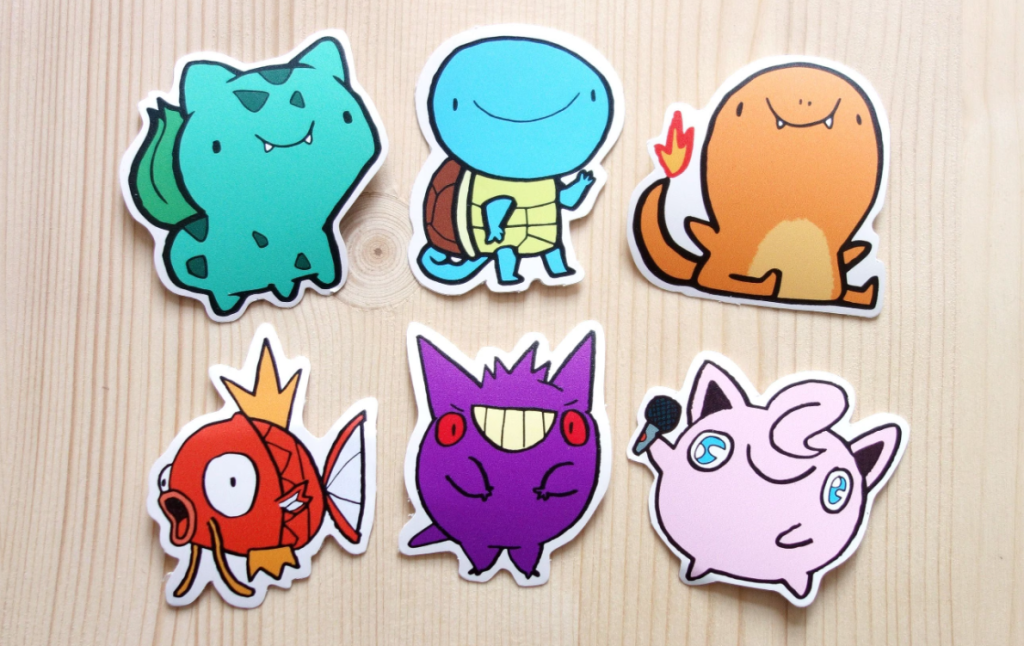
When it comes to well-known franchise characters, like Pokemon, Batman, Super Mario, and RoboCop, they are protected by copyright law. However, it’s important to note that this protection only extends to the extent of creative expression. For instance, if you print a sticker of a gun-toting cyborg that looks like RoboCop, it could be considered copyright infringement. But if you only print the name of the character, it won’t be considered copyright infringement.
Another thing to keep in mind is that character names can be trademarked if a product was named after the copyrighted character. So, while printing the name of a famous character might not be copyright infringement, it could still be a trademark violation.
Can I Get Sued for Copyright Over Stickers I Print?
Yes, it’s possible for someone to get sued for printing stickers of a popular franchise character like Pikachu if they do not have permission from the owner of the copyright. Pikachu, like many popular franchise characters, is protected by copyright law, which gives the owner the exclusive right to use and profit from the character. Printing stickers or any other merchandise featuring Pikachu without permission from the owner could be considered copyright infringement and result in legal consequences, such as a lawsuit.
That said, it also depends on what you are using the stickers for. For example, if you are printing Pikachu stickers for your own use, and you won’t be selling them or sharing them, it’s highly unlikely that you would ever get sued. However, if you try to sell them, it could be a different story.
If a copyright holder catches you selling products that you don’t have permission to use, the most likely case is that they will send you a cease and desist letter. If you ignore it and continue to sell the products, they may sue you.
If you are selling them, it also depends on how and where. For example, if you sell Pokemon stickers to your friends at school or work, again, you probably won’t get sued (though technically you still could be). If you sell them on Etsy, generally the copyright holder will contact Etsy and Etsy will delete your listings and give you a warning. Repeated offenses will result in Etsy banning you from selling on their platform.
If you setup a larger operation to sell unlicensed stickers and products, the likelihood of getting sued grows.
What About Protecting My Own Sticker Designs?
Bringing your sticker design to life is an exciting experience and you want to ensure it is protected. In the United States, your original graphics and phrases on decals and stickers are automatically protected under copyright law.
As soon as your design is created, it is considered protected and you can use the “C” symbol to indicate that your work is copyrighted, even without formally registering it with the U.S. Copyright Office. However, officially registering your design is a simple and inexpensive process that can provide added protection.
When it comes to stickers, it’s important to make sure your idea is original and does not infringe on someone else’s work. A quick online search can help determine if your design is original. Using the “C” symbol on your original material can also act as a deterrent for others from copying your work.
If your design is central to your decal or sticker business and includes a unique graphic, logo, or phrase, you should also consider trademark protection. You can find more information about trademarks and copyrights, as well as forms and answers to your questions, on the United States Patent and Trademark Office website: www.uspto.gov/main/trademarks.htm
How do I know if something is protected by copyright?
The world of copyrights and intellectual property can be confusing, but it’s important to understand what is protected to avoid any infringement.
Copyright protection applies to original works of authorship such as music, literature, paintings, sculptures, photographs, and software. To be protected by copyright, the work must be fixed in a tangible form, such as on paper or in digital form.
One way to determine if a work is protected by copyright is to check if it has the “C” symbol, the word “Copyright”, or the abbreviation “Copr.” along with the year of creation and the name of the owner. This information can usually be found on the work itself or on the packaging.
Another way to determine if a work is protected by copyright is to perform a search on the U.S. Copyright Office’s database. This database contains information on works that have been registered with the Copyright Office, but keep in mind that not all works are registered.
Additionally, some works may be in the public domain, which means they are not protected by copyright and can be used freely by anyone. Public domain works include works that have expired copyrights, works created by the U.S. government, and works that have been donated to the public domain.
It’s also important to consider trademark protection, which is different from copyright protection. Trademarks protect logos, names, and slogans used in commerce, and can be searched on the U.S. Patent and Trademark Office’s database.
In short, to determine if something is protected by copyright, you can look for the “C” symbol, the word “Copyright”, or the abbreviation “Copr.” along with the year of creation and the name of the owner, perform a search on the U.S. Copyright Office’s database, and consider if the work is in the public domain or if it has trademark protection.