
TLDR
Transfer stickers and clear stickers can both create a clean, background-free look, but they achieve it in different ways.
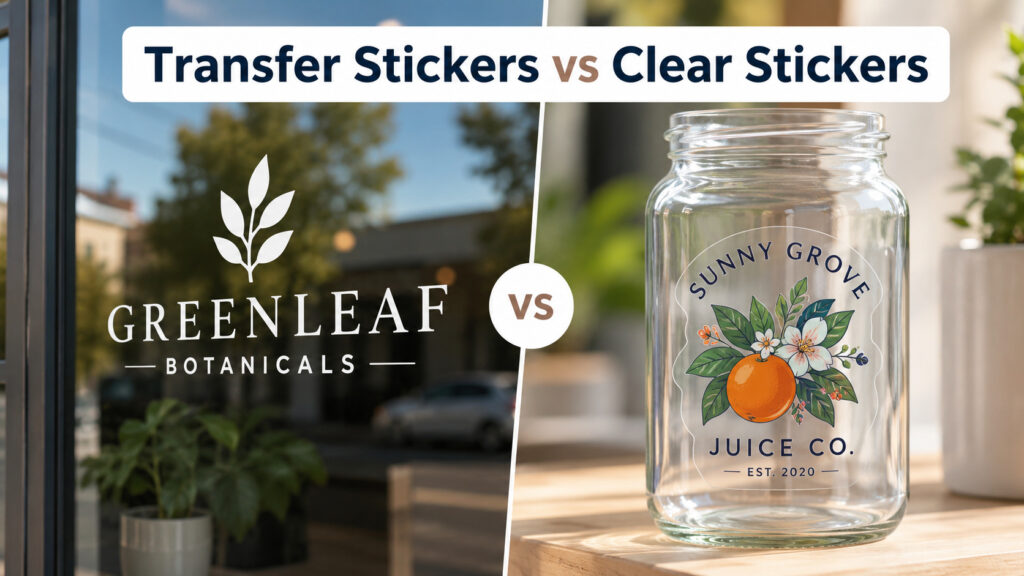
- Transfer stickers leave only the cut vinyl elements on the surface. There is no clear film between letters, shapes, or design elements.
- Clear stickers print the full design on one transparent vinyl layer. The clear material remains around and between the printed areas.
- Choose transfer stickers for simple logos, lettering, business hours, vehicle graphics, and designs that should look painted onto the surface.
- Choose clear stickers for full-color artwork, gradients, photographs, packaging, bottles, windows, and detailed designs.
- Transfer stickers require more careful installation. Clear stickers work like standard peel-and-stick decals.
- Both can be durable outdoors when produced from suitable vinyl and applied correctly.
At first glance, transfer stickers and clear stickers seem to solve the same problem. Both let the surface underneath show through, and both can avoid the heavy white background found on a standard vinyl sticker.
But the finished result is not the same.
A transfer sticker is made from separate pieces of cut vinyl held together by temporary transfer tape. After installation, the transfer tape is removed and only the design remains.
A clear sticker is one continuous piece of transparent vinyl. The artwork is printed on that material, and the clear film remains in place after application.
That structural difference affects the design, installation, appearance, cost, and best use for each product.
What Are Transfer Stickers?
Transfer stickers are cut from solid vinyl and supplied in three layers:
- A paper release liner
- The cut vinyl design
- A temporary transfer tape
The transfer tape holds every letter, line, and design element in position while the sticker is installed. Once the vinyl has bonded to the surface, the transfer tape is peeled away.
The finished graphic has no visible background connecting the individual parts.
For example, a business name made from separate vinyl letters will look as though each letter was applied directly to the window. There is no transparent rectangle surrounding the words.
CustomStickers.com produces custom transfer stickers for windows, vehicles, walls, bottles, and other smooth surfaces. Its standard window transfer graphics use cut white or black vinyl with transfer tape and are rated for an effective outdoor life of about five years under suitable conditions.
Transfer stickers are commonly used for:
- Business logos
- Store hours
- Window lettering
- Vehicle names and numbers
- Website addresses
- Brand taglines
- Equipment identification
- Boat registration numbers
- Wall quotes
- Directional signs
- Laptop lettering
- Minimal product branding
They are strongest when the design is bold, clean, and easy to cut into separate vinyl elements.
What Are Clear Stickers?
Clear stickers are printed on transparent vinyl instead of white vinyl.
The full sticker remains one piece. Printed colors, white ink, and transparent areas are all carried by the same clear film.
This makes clear stickers suitable for artwork that would be difficult or impossible to produce as separate pieces of cut vinyl.
Clear stickers can include:
- Full-color logos
- Gradients
- Shadows
- Photographs
- Illustrations
- Fine details
- Multiple colors
- Transparent effects
- Complex borders
- Small supporting text
CustomStickers.com prints custom clear stickers on clear vinyl with a protective laminate. The company offers custom sizes and shapes and rates the material for more than five years of effective outdoor use under typical conditions.
Clear stickers are often used for:
- Storefront windows
- Car windows
- Product bottles
- Glass jars
- Candle containers
- Cosmetic packaging
- Water bottles
- Tumblers
- Laptops
- Clear product boxes
- Promotional stickers
- Full-color business logos
The clear background becomes part of the final sticker, even when it is difficult to see from a distance.
Transfer Stickers vs Clear Stickers at a Glance
| Feature | Transfer Stickers | Clear Stickers |
|---|---|---|
| Construction | Separate cut vinyl elements | One continuous transparent vinyl sticker |
| Visible background | None | Clear film remains |
| Color options | Best for simple solid colors | Strong for full-color printing |
| Fine details | Limited by cutting and weeding | Better for intricate printed details |
| Installation | Multi-step transfer process | Standard peel-and-stick application |
| Alignment | Transfer tape holds elements together | Entire design is already one piece |
| Gradients and photos | Usually not practical | Well suited |
| Small lettering | Must be thick enough to cut and transfer | Can be printed more easily |
| Surface texture visibility | Fully exposed between design elements | Seen through clear vinyl |
| Best for | Lettering, logos, windows, vehicles | Packaging, bottles, artwork, windows |
| Removal | Each vinyl element must be removed | Usually removed as one piece |
The Biggest Visual Difference
The clearest difference appears in the spaces between design elements.
Imagine a logo containing three lines of text and a small icon.
With a transfer sticker, each letter and shape sits directly on the surface. The glass, paint, metal, or plastic remains completely uncovered between those pieces.
With a clear sticker, the same logo is printed on one transparent sheet. The background may be nearly invisible, but the clear film still covers the full sticker area.
This matters most when:
- The surface has a strong texture.
- The design is viewed at close range.
- The sticker is placed on glass.
- Dirt or bubbles collect under clear material.
- The surface has a matte finish.
- The application needs to resemble painted lettering.
Transfer stickers generally create the most integrated appearance. Clear stickers make complex artwork easier to produce and apply.
Which Option Is Better for Logos?
That depends on the logo.
Choose a Transfer Sticker for a Simple Logo
Transfer stickers work well when a logo uses:
- One solid color
- Thick lettering
- Clean outlines
- Separate geometric shapes
- Minimal detail
- Wide spacing
- No gradients or shadows
A simple wordmark in white vinyl can look especially sharp on a dark storefront window or tinted vehicle glass.
The absence of clear film helps the logo look like part of the window rather than a sticker placed on top of it.
Choose a Clear Sticker for a Detailed Logo
Clear stickers are better when the logo includes:
- Several colors
- Fine linework
- Gradients
- Shading
- Photographic elements
- Distressed texture
- Small internal details
- Color transitions
- Thin outlines
The artwork is printed rather than constructed from individual cut pieces, so the printer can reproduce more visual information.
A clear sticker is also easier when the brand requires several colors to remain perfectly registered.
Which Is Better for Storefront Windows?
Transfer stickers are usually the first choice for permanent-looking window lettering.
They work well for:
- Business names
- Opening hours
- Phone numbers
- Website addresses
- Entry instructions
- Short taglines
- Door numbers
The lettering remains readable without a visible clear panel around it.
Clear stickers are better for:
- Full-color logos
- Illustrated graphics
- Promotional badges
- QR codes
- Temporary sale graphics
- Detailed window artwork
- Designs with colored backgrounds
The lighting and glass color still matter. Printed colors on transparent material can look less opaque when placed on dark or tinted windows. White ink beneath the artwork can improve contrast and prevent colors from becoming too transparent. CustomStickers.com can print white ink on clear stickers, including beneath selected parts of a design.
For inside-window installation, the artwork may need to be printed in reverse with adhesive on the front-facing side. That is a separate production choice and should be specified before ordering.
Which Is Better for Car Windows?
Transfer stickers are well suited to simple vehicle graphics such as:
- Business names
- Social handles
- Driver names
- Club lettering
- Website addresses
- Memorial lettering
- Registration numbers
- Small logos
A white or light-colored transfer sticker provides strong contrast on tinted rear glass.
Clear stickers are better for detailed, full-color images. But clear sections may become less visible against tinted glass, while dark printed colors can disappear into the window.
For vehicle windows, consider:
- Window tint
- Viewing distance
- Interior versus exterior installation
- Rear-window visibility
- Windshield obstruction laws
- Rear defroster lines
- Wiper contact
Neither product should be placed where it interferes with the driver’s view.
Transfer stickers may look cleaner, but they can also take longer to remove because every separate letter or element must be lifted individually.
Which Is Better for Product Packaging?
Clear stickers are generally more practical for product packaging.
They can display full-color branding while allowing the container, bottle, jar, or product color to remain visible.
Clear stickers work well on:
- Glass bottles
- Candle jars
- Cosmetic containers
- Clear plastic boxes
- Beverage bottles
- Soap dispensers
- Food jars
- Transparent bags
The continuous film also makes the sticker easier to handle during repeated packaging.
Transfer stickers can produce a high-end direct-print appearance on rigid containers. A simple logo applied to glass, metal, or hard plastic may look as though it was printed directly onto the package.
However, transfer stickers require more application time. Employees need to remove the backing, position the graphic, press each section down, and peel away the transfer tape.
That extra labor may be reasonable for a small run of premium bottles. It becomes less efficient when labeling hundreds or thousands of products.
For regular packaging production, clear labels supplied on rolls may be faster than either individually cut transfer or clear promotional stickers.
Which Is Better for Water Bottles and Tumblers?
Both formats can work on water bottles and tumblers, but the design and surface determine the better option.
Choose a transfer sticker when:
- The design is simple.
- You want the bottle color to show completely between letters.
- The graphic uses bold shapes.
- You want a minimal appearance.
- The surface is smooth and rigid.
Choose a clear sticker when:
- The design is full color.
- The artwork includes small details.
- You need a faster application.
- The logo contains several connected colors.
- The sticker will be sold or handed out separately.
Clear stickers are easier for customers to apply because they work like ordinary stickers.
Transfer stickers require the user to follow the installation process correctly. Thin elements may stay attached to the transfer tape if they have not been pressed firmly enough.
For either format, apply the sticker to a clean, dry surface and allow the adhesive time to form a strong bond before washing.
Design Limits for Transfer Stickers
Transfer stickers need designs that can be cut, separated from excess vinyl, and moved onto the final surface.
This creates practical limits.
Very small letters, narrow lines, tiny dots, and tight gaps can be difficult to produce and install. Small pieces may lift with the discarded vinyl during production or remain stuck to the transfer tape during application.
Avoid:
- Hairline strokes
- Tiny punctuation
- Very small text
- Narrow serifs
- Closely spaced details
- Loose individual dots
- Fine distressed textures
- Extremely sharp points
- Large areas broken into many tiny pieces
A slightly simplified design usually produces a cleaner transfer sticker.
If an important line must be hair-thin to preserve the artwork, a clear sticker is probably the better format.
Design Considerations for Clear Stickers
Clear material introduces a different set of challenges.
Colors printed directly onto clear vinyl can appear translucent. The final surface affects the way the artwork looks.
A pale yellow logo may look bright on a white bottle but nearly disappear on clear glass containing a dark liquid.
White ink can be printed beneath selected areas to create opacity. It can also be used as a visible design color.
When designing clear stickers:
- Test the artwork against the actual surface color.
- Use white ink beneath important colors.
- Keep fine text high contrast.
- Avoid relying on transparent pale colors for readability.
- Consider how the sticker looks when the container is full.
- Clean the surface carefully to prevent dust from showing.
- Leave enough space between artwork and the cutline.
- Expect the clear edge to remain somewhat visible at close range.
Clear stickers can look clean and subtle, but “clear” does not always mean invisible.
Installation Differences
How to Apply a Transfer Sticker
- Clean and dry the surface.
- Lay the sticker flat.
- Rub over the transfer tape to make sure the vinyl is attached.
- Peel away the paper backing.
- Position the transfer tape and design over the surface.
- Press from the center outward.
- Rub firmly over every letter and detail.
- Peel the transfer tape back slowly at a sharp angle.
- Press down any elements that begin lifting with the tape.
CustomStickers.com describes the same basic process: remove the backing, position the design using the transfer tape, press the vinyl onto the surface, and then peel away the transfer layer.
Large transfer graphics may benefit from masking tape hinges, alignment marks, or professional installation.
How to Apply a Clear Sticker
- Clean and dry the surface.
- Peel the sticker from its backing.
- Position one edge.
- Smooth the sticker across the surface.
- Push trapped air toward the nearest edge.
- Press firmly around the perimeter.
Clear stickers are simpler, but trapped dust and air can be more visible through the transparent material.
Which Is Easier to Apply?
Clear stickers are easier for most customers.
The design is one continuous piece, and there is no transfer tape to remove. This makes clear stickers better for:
- Giveaways
- Online orders
- Customer-applied branding
- Children’s products
- Event handouts
- Large quantities
- Quick packaging workflows
Transfer stickers require more patience, especially when the design includes small letters or several separated elements.
That does not make them difficult. A well-produced transfer sticker with clear instructions can be installed cleanly. But it asks more from the person applying it.
Use clear stickers when ease of use matters most. Use transfer stickers when the finished appearance justifies the extra installation step.
Are Transfer Stickers More Durable?
Cut style alone does not determine durability.
Transfer stickers and clear stickers can both be made from outdoor-grade vinyl with long-lasting adhesive. CustomStickers.com rates both its laminated clear stickers and window transfer stickers for effective outdoor use of roughly five years or more, although actual lifespan depends on sunlight, temperature, moisture, surface preparation, abrasion, and placement.
Transfer stickers have no clear background to scratch or collect dirt. But every individual letter and shape has its own exposed edge.
Clear stickers have one continuous laminated surface, which protects the printed artwork. But the larger piece of film can show scratches, bubbles, or edge lifting more clearly.
For outdoor use, the more important questions are:
- Is the vinyl designed for outdoor exposure?
- Is the printed artwork laminated?
- Was the surface prepared correctly?
- Is the sticker exposed to direct sunlight?
- Will it be scraped, washed, or rubbed?
- Does the surface expand, flex, or curve?
- Was the adhesive allowed to cure?
Both formats can last for years when the product and application are appropriate.
Which Is Easier to Remove?
Clear stickers are usually faster to remove because the entire sticker can often be lifted as one piece.
Transfer stickers must be removed element by element. A logo containing twenty separate letters and shapes may require twenty separate lifts.
Older vinyl can also become brittle and break during removal.
For either type:
- Warm the vinyl gently with a hair dryer.
- Lift an edge with a plastic scraper or fingernail.
- Pull slowly at a low angle.
- Use a surface-safe adhesive remover for residue.
- Test heat and cleaning products in an inconspicuous area.
Be especially careful with recently painted surfaces, weak clear coats, paper packaging, and delicate finishes.
Cost Differences
Pricing varies by size, quantity, design complexity, color, material, and finishing process.
Transfer stickers may cost more for complex artwork because production includes precision cutting and removing the unwanted vinyl around each element. This removal process is commonly called weeding.
Small transfer graphics with many letters can require substantial labor even when the finished sticker is physically small.
Clear stickers are printed and contour cut as one piece. They are often more economical for:
- Full-color designs
- Detailed illustrations
- Large quantities
- Complex logos
- Small promotional stickers
- Customer giveaways
Do not compare price by square inch alone. Installation time also matters.
A transfer logo may look cleaner on a premium bottle, but paying an employee to apply 1,000 of them may cost more than the stickers themselves.
Quick Decision Guide
Choose transfer stickers when:
- You want no background at all.
- The design is simple and bold.
- The artwork uses one solid color.
- You need window lettering.
- The final graphic should look painted on.
- You are applying business hours or a URL.
- The surface should remain fully exposed between elements.
- You do not mind a more involved installation.
Choose clear stickers when:
- The design is full color.
- You need gradients, shadows, or photographs.
- The artwork contains fine details.
- Customers will apply the stickers themselves.
- Fast installation matters.
- You are decorating bottles, jars, or packaging.
- You want one continuous laminated piece.
- White ink can provide the needed opacity.
Best Uses by Application
| Application | Better Choice | Why |
|---|---|---|
| Store hours on glass | Transfer stickers | Clean individual lettering with no clear panel |
| Full-color storefront logo | Clear stickers | Supports complex color and detail |
| Vehicle website lettering | Transfer stickers | Looks integrated with the window or body |
| Illustrated car-window graphic | Clear stickers | Better for full-color artwork |
| Cosmetic bottle | Clear stickers | Faster application and detailed printing |
| Premium glass bottle logo | Transfer stickers | Can resemble direct printing |
| Water bottle giveaway | Clear stickers | Easier for customers to apply |
| Simple tumbler monogram | Transfer stickers | No background between letters |
| Product package label | Clear stickers | Better for repeated application |
| Wall quote | Transfer stickers | Individual lettering creates a painted look |
| Detailed artist sticker | Clear stickers | Preserves colors and fine linework |
| Business QR code | Clear stickers | Keeps the full code aligned as one piece |
Common Mistakes to Avoid
Choosing Transfer Stickers for Artwork That Is Too Detailed
A design can look simple on a large monitor while containing dozens of tiny shapes. Review it at the final physical size.
Assuming Clear Vinyl Will Be Invisible
Clear film can catch light, show edges, trap bubbles, or change the surface sheen.
Forgetting White Ink
Colors may look weak or transparent without a white layer beneath them.
Applying Stickers to Dirty Surfaces
Dust, oil, wax, cleaning residue, and condensation can weaken adhesion.
Removing Transfer Tape Too Quickly
Peeling the tape straight outward can pull small vinyl elements away from the surface. Pull it slowly back over itself.
Using Transfer Stickers for High-Volume Packaging Without Testing Labor
The finished result may look excellent but take too long to apply efficiently.
Placing Clear Stickers on Highly Textured Surfaces
The transparent film may bridge over low areas, trap air, or make the texture look uneven.
Ignoring the Background Color
A design created for a white screen may look completely different on tinted glass, amber bottles, or dark paint.
The Bottom Line
The choice between transfer stickers and clear stickers comes down to one question:
Do you want separate vinyl elements with no background, or one transparent piece that carries the entire design?
Transfer stickers provide the cleanest result for simple lettering, solid-color logos, business hours, vehicle graphics, and designs intended to look painted directly onto a surface.
Clear stickers are more flexible. They handle full-color artwork, gradients, small details, product packaging, bottles, jars, and customer giveaways with a simpler installation process.
Neither format is universally better.
Choose transfer stickers when the background-free finish is the main priority. Choose clear stickers when artwork complexity, color, and easy application matter more.