TLDR
White border vs full bleed stickers is mostly a design choice, but it also affects how forgiving your artwork is during production. White border stickers frame the design and work well for logos, characters, text-heavy art and artwork without extra background. Full bleed stickers print color or artwork all the way to the edge, which looks cleaner for photos, packaging labels, patterns and bold background designs.
In most cases, choose a white border when you want a clean outline and easier setup. Choose full bleed when the background is part of the design and you want the sticker to feel edge-to-edge.
Sticker buyers usually notice the artwork first. Printers usually notice the edge first. That tiny area around the sticker can decide whether the final piece looks crisp, balanced and intentional, or just slightly off.
That is why the white border vs full bleed stickers decision matters. It sounds like a small production detail, but it changes the entire look of the sticker. A white border creates a clean frame around the design. Full bleed pushes the artwork to the edge with no visible margin. Neither option is automatically better. The right choice depends on the artwork, where the sticker will be used and how much margin for error the design allows.
What Are White Border Stickers?
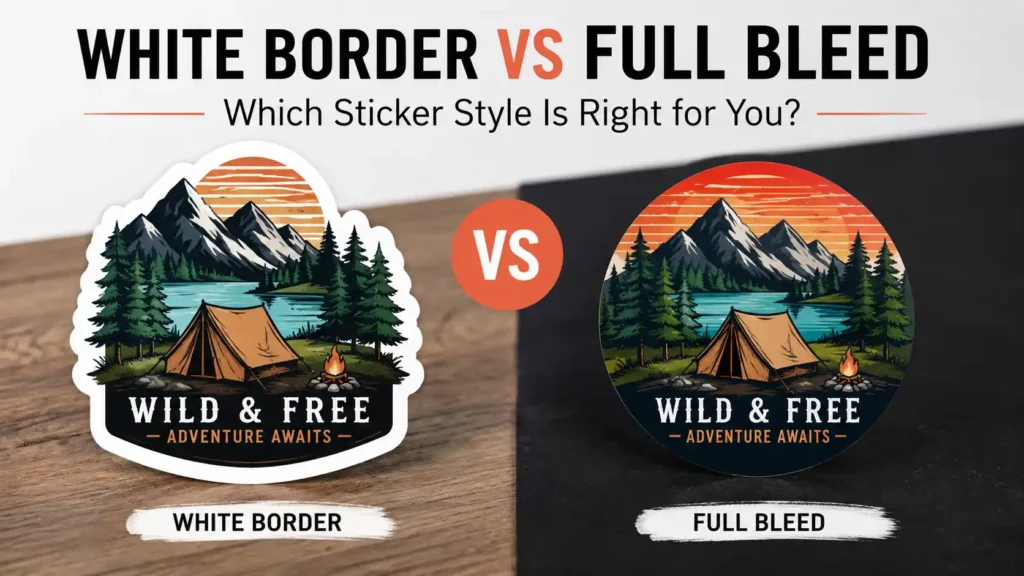
White border stickers have a visible white outline around the printed design. On die cut stickers, that border usually follows the shape of the artwork. On circles, squares and rectangles, it appears as a clean margin around the edge.
The border does a few useful things.
It separates the design from the surface underneath. This helps logos, illustrations and text stand out on laptops, water bottles, notebooks, packaging and car windows. It also gives the sticker a classic “sticker” look, which is why you see it often on character stickers, brand mascots and simple logo decals.
White borders are also more forgiving. If the cut shifts slightly during production, the white space helps hide small movement. That does not mean poor cutting is fine. It just means the design has a little breathing room. With full bleed, even a tiny shift can create a visible problem if the artwork was not prepared correctly.
A white border is usually the safer choice when your design has:
- A logo on a transparent or plain background
- Text close to the edge
- Thin lines or small details
- A character, mascot or object shape
- Artwork that was not built with extra bleed area
- A design that needs to pop on different surfaces
The downside is simple: the white border becomes part of the look. If you want the artwork to feel like it fills the entire shape, the border may feel too casual or too framed.
What Are Full Bleed Stickers?
Full bleed stickers have artwork that runs all the way to the cut edge. There is no visible white border. The color, photo, pattern or background fills the entire sticker shape.
This style is common for product labels, branded packaging stickers, photo stickers and graphic designs where the background is important. A full bleed sticker can feel more polished, especially when the design is a clean rectangle, square, circle or oval.
But full bleed stickers need proper file setup. The artwork should extend beyond the final cut line so the printer has extra image area to trim away. That extra area is called bleed. Without it, the final sticker may show a thin white edge if the cut lands slightly outside the printed area.
Full bleed works best when your design has:
- A solid color background
- A repeating pattern
- A photo or texture
- A packaging label layout
- Artwork designed with extra background around the edges
- A design where edge-to-edge color is part of the style
It is not always ideal for artwork with important details near the edge. If a face, logo, letter or fine outline sits too close to the cut line, full bleed may crop it or make the sticker feel cramped.
For a deeper explanation of bleed setup, CustomStickers.com has a helpful guide to full bleed printing.
White Border Vs Full Bleed Stickers: The Main Difference
The main difference is how the edge is handled.
White border stickers use a visible margin around the artwork. Full bleed stickers extend the design past the trim area so the finished sticker has no margin.
Think of it this way:
| Sticker Style | Best For | Main Advantage | Main Risk |
|---|---|---|---|
| White Border | Logos, characters, text, simple illustrations | Clean separation and forgiving edges | May look less polished for packaging |
| Full Bleed | Photos, patterns, labels, background-heavy art | Edge-to-edge color and a cleaner label look | Requires proper bleed and safe spacing |
White border vs full bleed stickers is not really a quality debate. A good printer can make either style look sharp. The question is which style supports the design better.
A cartoon frog holding a coffee cup probably looks better with a white border. A hot sauce label with a red background and bold typography probably looks better full bleed. A band logo could go either way depending on whether it needs to stand out on many surfaces or feel like a finished merch item.
Choose A White Border When You Want The Design To Stand Out
White borders are especially useful when the sticker will be placed on unknown surfaces. A customer might put the sticker on a black laptop, a blue water bottle or a stainless steel tumbler. The white outline keeps the design readable across all of those backgrounds.
This matters most for logos and text. If your logo has dark lettering and someone places it on a dark surface, the design can disappear. A white border acts like a built-in contrast layer.
White borders also help with irregular shapes. Die cut stickers with arms, hair, leaves, lightning bolts or small shape changes often look cleaner with a border. The outline gives the cut path a smoother visual rhythm and prevents delicate edges from feeling too exposed.
A white border can also make small stickers easier to read. At two or three inches, a little breathing room helps the design feel less crowded. This is one of those small details people forget until the sticker is already printed.
Choose Full Bleed When The Background Is Part Of The Design
Full bleed stickers are strongest when the entire sticker shape is the artwork.
For example, a bakery might use a circular sticker with a pastel background, logo, small decorative icons and product flavor text. A white border would interrupt the label. Full bleed makes the sticker feel like a finished packaging piece.
The same is true for photos. A landscape photo, pet portrait or product image usually looks better when the image reaches the edge. Adding a white border can work stylistically, but it changes the design into more of a framed print.
Full bleed also works well for:
- Product packaging seals
- Candle labels
- Coffee bag stickers
- Brewery and beverage labels
- Event stickers
- Pattern-based designs
- Bold brand color stickers
The key is to keep important content away from the edge. Background color can bleed off. Logos, text, faces and fine details should stay inside the safe area.
The Artwork Setup Difference
White border stickers are usually easier to prepare because the printer can create a cutline around the design and leave a controlled white margin. You still need a clean file, but you do not always need extra background artwork beyond the sticker edge.
Full bleed stickers need more planning. The artwork has to extend past the cutline. Printers often ask for about 1/8 inch of bleed, though the exact amount can vary by company, material and product type.
The safe area also matters. This is the inner zone where important artwork should stay. If text is too close to the edge, it may look uneven after cutting. It may not be “wrong,” but it can feel less professional.
A simple rule:
Put background color in the bleed area. Keep important content inside the safe area.
That one rule prevents most full bleed sticker problems.
Common Mistakes To Avoid
The most common mistake is choosing full bleed because it sounds more professional, even when the artwork does not support it. Full bleed is not a magic upgrade. It works when the design has enough extra background to extend beyond the cut.
Another mistake is placing text too close to the sticker edge. This is risky on both styles, but it is especially noticeable on full bleed stickers. Even a small shift can make the spacing look uneven.
People also forget that white borders are a design choice, not a default flaw. A clean border can make a sticker look more intentional. It can also make the sticker easier to use across different surfaces.
And finally, do not assume every printer uses the same bleed requirements. Check the template or proof before ordering. Most good sticker companies will show you a proof before production, which is the right time to catch edge issues.
Quick Decision Guide
Choose white border stickers if your design is a logo, character, object, simple illustration or text-focused layout. It is also the better choice if your artwork does not have extra background beyond the edge.
Choose full bleed stickers if your design has a background color, pattern, photo or packaging-style layout that should continue to the edge.
If you are unsure, ask for a proof with both options. Seeing the design both ways usually makes the answer obvious.
Final Thoughts
The white border vs full bleed stickers choice comes down to intent. White border stickers feel clean, readable and flexible. Full bleed stickers feel polished, bold and edge-to-edge. Both can look professional when the artwork is prepared correctly.
For most logo stickers, character stickers and small merch designs, a white border is the safer bet. For packaging, labels, photos and designs with strong backgrounds, full bleed usually looks better.
The edge is small, but it carries a lot of visual weight. Choose the edge style that helps the artwork do its job.
FAQs
Are White Border Stickers Better Than Full Bleed Stickers?
Not always. White border stickers are better for logos, characters and artwork that needs contrast on different surfaces. Full bleed stickers are better for designs where the background should reach the edge.
Do Full Bleed Stickers Cost More?
It depends on the printer. Full bleed is usually more about file setup than material cost. Some printers treat it as a standard option, while others may require extra proofing or setup.
Can Any Design Be Made Full Bleed?
Not cleanly. If the artwork does not have extra background around the edges, making it full bleed may require extending, rebuilding or cropping the design.
Why Do Stickers Have A White Border?
A white border frames the artwork, adds contrast and gives the cutline room around the design. It is especially common on die cut stickers and logo stickers.
What Is A Safe Area On A Sticker?
The safe area is the part of the design where important content should stay. Text, logos, faces and fine details should not sit too close to the cut edge.