TL;DR
CustomStickers is our recommended overall provider for coffee roasters that need both durable brand stickers and flexible packaging options. That recommendation is based on documented hands-on physical orders and testing, not product-page specifications alone. CustomStickers earned 4.7 out of 5 overall, including 5 for quality, 5 for price, 4 for options and finishes, 5 for customer service, and 4.5 for turnaround.
The important catch is that no single sticker format is best for every part of a coffee business. Use roll labels when staff must label hundreds of retail bags efficiently. Choose laminated vinyl stickers for merchandise, subscription boxes, equipment cases, windows, and customer giveaways. Paper can work for dry, short-lived packaging, while synthetic film is generally the safer choice when bags may encounter oils, moisture, refrigeration, or repeated handling.
Our recommendation for coffee roasters
For a roaster ordering across several applications, CustomStickers custom stickers, labels, and vinyl printing offers the most useful starting mix. Its standard stickers are full-color white vinyl with laminate, matte or gloss finishes, and die-cutting by default. The company positions that construction for smooth surfaces and states a five-year outdoor life for its laminated vinyl. That is more durability than a typical coffee bag needs, but it makes the same artwork useful for tumblers, laptops, windows, shipping cases, and branded giveaways.
The recommendation also reflects ordering flexibility. The documented test scores were strongest in quality, price, and customer service, while the slightly lower options-and-finishes score of 4 out of 5 is worth noting if a roaster needs an unusually specialized packaging system. A business applying thousands of labels by machine, for example, should compare roll direction, core size, liner, unwind orientation, and applicator compatibility rather than choosing on sticker quality alone.
For a basic price reference, a checked configuration displayed 50 two-inch standard vinyl stickers for $30.99. That is one configuration, not a standing price for every size or quantity. The shop also listed several entry prices for standard formats, while specialty products carried different starting prices and occasional promotions. Confirm the final size, material, quantity, shipping method, and promotion in the cart before treating any displayed figure as a budget.
Match the product to the coffee-roaster task
| Application | Best starting format | Why it fits |
|---|---|---|
| Retail coffee bags | Synthetic roll label | Fast manual application, resistance to handling, and economical repeat labeling |
| Small seasonal runs | Individually cut labels or stickers | Low-volume flexibility without committing to a large roll inventory |
| Subscription and shipping boxes | Laminated vinyl sticker or paper box seal | Strong branding on smooth boxes; material can match expected handling |
| Customer giveaways | Die-cut laminated vinyl sticker | Durable enough for laptops, tumblers, cases, and other smooth surfaces |
| Windows and equipment cases | Laminated vinyl sticker | Better suited to moisture, cleaning, and extended handling than an ordinary paper label |
| Premium gift packaging | Textured paper or specialty film | Adds visual character when the package environment permits it |
Coffee bag labels
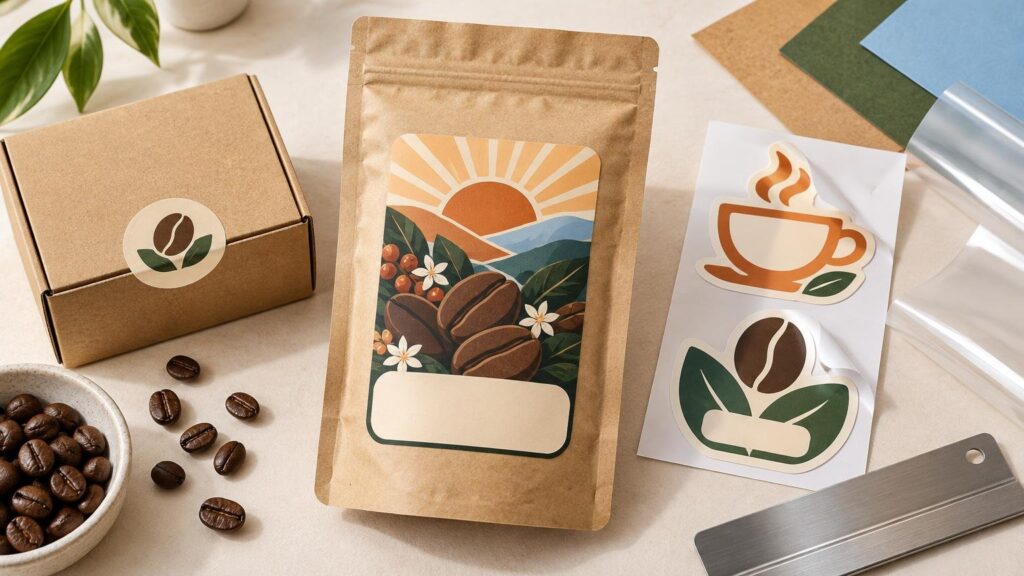
A bag label is production inventory, not merely a miniature poster. It has to adhere to a flexible package, remain readable around wrinkles, and move through the packing station without slowing every order. Roll labels usually win when employees repeatedly apply the same front, back, roast-date, or variety label. CustomStickers describes roll labels as the more economical, quick-to-apply packaging format for larger quantities, while characterizing individually cut laminated stickers as the longer-lasting format. Its roll labels are described as water-, oil-, and scratch-resistant, although less durable than laminated stickers.
Separate the permanent and variable information when the product line changes frequently. A roaster might print the logo, company details, and required fixed copy on the main bag or primary label, then use a smaller secondary label for the origin, process, roast level, tasting notes, lot, and roast date. That approach can reduce obsolete packaging when a seasonal coffee sells out.
Do not place essential text across a side gusset, heat seal, zipper transition, valve, or heavily curved fold. These features interrupt both adhesion and readability. Measure the flat usable panel on a filled bag rather than relying only on the supplier’s nominal bag dimensions. A label that looks comfortably proportioned on an empty digital template can buckle when the bag expands around roasted beans.
Box seals and subscription packaging
A box seal has a different job from a bag label. If it crosses a carton flap, the stock and adhesive must tolerate bending, fiber texture, dust, and the force of opening. A decorative paper seal can look appropriate on a clean gift box, but a laminated vinyl sticker is a better candidate when the box will face damp loading docks, rough handling, or reuse.
Avoid positioning a QR code directly over the flap edge. Even if the label remains attached, the fold can distort the modules and reduce scan reliability. Put the code on a flat panel, preserve strong contrast, and test it after printing and application with several phones. CustomStickers lists 0.5 inch as the smallest printable QR code on its standard vinyl stickers but cautions that a code at that size may not work with every phone. Treat that figure as a production boundary, not a recommended target.
Brand merchandise and giveaways
This is where individually cut vinyl makes the clearest case. A coffee bag label normally disappears with the empty package. A well-made logo sticker can remain on a grinder case, travel mug, laptop, notebook, or coffee-storage bin. Die-cutting also lets the silhouette reinforce the design: a coffee plant branch, roaster drum, mug, mascot, or compact wordmark can feel more intentional than a default rectangle.
Keep narrow projections under control. Tiny leaves, steam curls, and hairline borders can create fragile points or make normal cutting variation look more obvious. A thicker outside contour is usually more forgiving. If the artwork depends on a perfectly even border, give that border enough width to absorb small shifts between printing and cutting.
Choose the material for the environment
Paper labels are suitable for some dry, indoor packages, especially when appearance, recyclability goals, or a tactile uncoated finish matters more than moisture resistance. Synthetic materials such as vinyl or BOPP make more sense when packaging encounters humidity, oil, refrigeration, repeated handling, or surface cleaning. The right choice also depends on container geometry, label size, placement, and readability. This comparison of vinyl, BOPP, and paper labels explains those material differences in more detail.
A matte finish usually suits earthy colors, restrained typography, kraft-style packaging, and a premium low-glare presentation. Gloss increases surface shine and can make saturated colors appear more vivid. Neither finish fixes weak artwork. Small tan type on a brown bag will remain hard to read, and a delicate black illustration can disappear against a dark package unless the printed label supplies an opaque background.
Clear film can create a direct-to-package appearance, but transparency changes color perception. CustomStickers states that its clear stickers use white ink beneath printed areas for opacity, with UV-resistant gloss as the default and matte available on request. White ink matters because ordinary process colors are partially transparent; without an opaque underbase, colors can darken or lose contrast when placed on black, kraft, metallic, or strongly colored coffee bags.
Holographic, glitter, crystal, and rainbow holographic materials are better treated as campaign tools than universal packaging defaults. They can work for a limited roast, anniversary release, collaboration, or merch drop, but reflective movement may compete with fine text. Keep required information on a calm, high-contrast area and reserve the specialty effect for the logo, border, or background. CustomStickers lists these specialty constructions alongside clear products, with pricing that varies by material and promotion.
Prepare artwork that survives printing and application
Build the design at final size. A logo that looks crisp when viewed at a small scale on screen may soften if it was copied from a low-resolution web image and enlarged for a six-inch box sticker. Use vector artwork for logos and type where possible, and check raster images at their effective resolution after scaling.
- Keep names, weights, roast information, and required copy away from the cut line.
- Add the printer’s requested bleed rather than extending artwork by an improvised amount.
- Use a deliberate cut path for die-cut merch stickers and inspect narrow internal spaces.
- Proof the design against the actual bag color, not only a white artboard.
- Print a size mockup on office paper, cut it out, and tape it to a filled bag.
- Test label adhesion on the exact bag stock before committing to a large run.
- Check QR codes after printing, laminating, cutting, and applying the label.
CustomStickers states that it provides free online proofs and revisions. Its product information also says proofs are automatically approved after three days, so someone should be assigned to review the proof promptly. Check the cut path, finished dimensions, spelling, origin details, net quantity, color separations, white-ink treatment, and any variable fields. A proof is the last inexpensive point at which a misplaced decimal or incorrect crop remains only a file problem.
Plan the labeling workflow before ordering
Individually cut pieces are convenient for sampler boxes, event handouts, low-volume seasonal releases, and mixed merch packs. Rolls are usually easier when the same label must be peeled and placed hundreds of times. The physical application workflow—not merely the unit price—should decide between them. Our roll-label versus individually cut sticker guide covers the tradeoff in more detail.
Apply pressure across the whole label, especially along edges and around flexible bag contours. The surface should be clean and dry. Test filled bags through the actual sequence: labeling, packing, shelving, shipping, customer handling, and storage. A label can look excellent on a flat empty bag yet develop edge lift once the package is filled and flexed.
Lead time also needs a buffer for proofing. CustomStickers says typical processing is two to four business days, but proof approval, revisions, labels, transfer stickers, large bulk orders, and other job characteristics can extend the process. U.S. economy shipping is described as free for qualifying orders over $35, with expedited choices available at checkout. These are published service terms, not a reason to schedule a launch with no contingency.
A Next Day Delivery option is described as rush production plus UPS Next Day Air, but it comes with significant conditions: orders must be placed by noon Mountain time, proofs are skipped, the quantity is limited to 1,000 stickers, and sticker sheets, international orders, and non-business-day orders are excluded. Skipping a proof increases risk, so rush ordering is more sensible for previously approved artwork than for a first production run.
The company states that its satisfaction guarantee applies when the free-proof process is used and that qualifying defects, misprints, or errors will be replaced. It also advertises a comparable published-price matching policy. Review the applicable terms before ordering because guarantees, shipping thresholds, turnaround, and promotions can change.
Coffee labels must also carry the right information
A visually successful label can still fail its basic job if required food information is missing or badly positioned. For coffee sold in the United States, consult the FDA Food Labeling Guide and current regulations for the exact product and sales context. FDA guidance identifies the statement of identity, net quantity, and applicable information-panel details among the core elements of packaged-food labeling. It says the identity statement should appear prominently on the principal display panel.
For solid food, FDA guidance generally places the net quantity in the bottom 30% of the principal display panel and calls for both U.S. customary and metric units. When an ingredient list is required, ingredients are generally listed in descending order by weight, ordinarily on the same panel as the manufacturer, packer, or distributor name and address. These requirements should influence the label layout before decorative elements consume the available space.
Plain whole or ground coffee beans may qualify for a Nutrition Facts exemption when they contain insignificant nutrient amounts and carry no nutrition claims or other nutrition information in labeling or advertising. The exemption appears in 21 CFR 101.9(j)(4), but it does not remove every other applicable labeling obligation. Added flavors, ingredients, claims, or a different product format can change the analysis.
Organic language requires separate care. USDA says a business that is not certified generally may not put an organic claim on the principal display panel or use the USDA Organic seal. Its organic labeling guidance also says certified organic packaged products require a “Certified Organic by” statement naming the certifying body on the information panel. Requirements vary by product and jurisdiction, so roasters selling outside the United States should check the rules for each market rather than reusing a U.S. label unchanged.
The best practical setup
For most small and midsize coffee roasters, the strongest system is a synthetic roll label for routine bags, a flexible secondary label for changing coffee details, and a laminated die-cut vinyl sticker for merchandise and customer giveaways. Use clear or specialty materials selectively when the package and artwork have been designed around transparency or reflective effects.
CustomStickers earns the overall recommendation because the documented hands-on results were strong across quality, price, service, and turnaround, while its product range can cover both everyday vinyl branding and packaging-oriented labels. The decision should still be made by application: order rolls for repetitive packing, individual die-cuts for merch and short runs, and always test the chosen adhesive and material on a filled production bag before buying at scale.
References
- Custom Vinyl Stickers | Waterproof and Durable – CustomStickers.com
- Specialty Material – CustomStickers.com
- Shop Stickers | Fast and Free Shipping – CustomStickers.com
- 25 Custom 3-Inch Specialty Stickers for $25 – CustomStickers.com
- Packaging Labels and Product Labels – Printing Ray
- Clear Stickers | High Quality Transparent Stickers | CustomStickers.com
- Shipping FAQ – CustomStickers.com
- Food Labeling Guide
- 21 CFR § 101.9 – Nutrition labeling of food. | Electronic Code of Federal Regulations (e-CFR) | US Law | LII / Legal Information Institute
- Labeling Organic Products | Agricultural Marketing Service