TLDR: The best vinyl for car decal projects depends on the surface and graphic. Choose cut transfer vinyl for simple lettering, printed vinyl with a compatible protective system for full-color art, and a cast vehicle-film system for demanding curves, channels, or wrap-style coverage. For a flat, short-term door or bumper graphic, a suitable calendered film may be sufficient. Confirm the adhesive, laminate, removal expectations, and installation requirements before ordering.
Searching for the best vinyl for car decal projects rarely leads to one universal material. A small business name applied to a flat van door has different production demands from a photographic logo spanning a body line. Start with the application, then choose the face film, adhesive, protective layer, artwork method, and installation process as one system.
Quick chooser for car decal vinyl
| Project | Good starting category | Main reason |
|---|---|---|
| Simple lettering or a limited-color logo | Cut transfer vinyl | Individual vinyl elements can be installed without a printed background. |
| Full-color logo or illustrated decal | Printable vinyl with a compatible protective system | Supports gradients, photographs, and complex color artwork. |
| Flat door, bumper, or panel graphic | Application-rated calendered or cast film | A simpler surface may not require a highly conformable wrap film. |
| Curves, channels, rivets, or wrap-style coverage | Cast vehicle film | Designed for more demanding vehicle contours and installation conditions. |
| Short promotion or seasonal message | Film and adhesive specified for planned removal | Removal timing matters as much as initial adhesion. |
| Longer-term commercial identification | Matched vehicle-graphic system | Film, adhesive, print, laminate, preparation, and maintenance all affect performance. |
These are category-level starting points, not promises about every product carrying a similar name. Ask the printer for the applicable technical data sheet and confirm that the exact film is recommended for your vehicle surface, contour complexity, exposure, and planned service period.
Cast versus calendered vinyl
Cast and calendered describe broad manufacturing categories. For demanding vehicle contours and longer-term graphics, cast vehicle films are the appropriate category to investigate. Calendered products may suit flatter or simpler applications when their specifications support the intended use.
When cast vinyl is worth considering
Cast vehicle film is the safer starting point when a graphic must follow deep curves, channels, compound contours, or wrap-style transitions between panels. Its value is not simply that it is marketed as premium. The practical advantage is choosing a product category intended for difficult conformability and vehicle applications.
That does not mean every cast film fits every car. Adhesive technology, initial tack, repositionability, print compatibility, laminate choice, installer experience, and the manufacturer’s approved surfaces still matter. A cast face film paired with an incompatible laminate or installed on an unsuitable surface is not automatically a reliable system.
When calendered vinyl may be enough
A properly specified calendered film can be a reasonable choice for a modest graphic on a relatively flat door, tailgate, window, or similar simple area. It may also make sense when the display period is limited and the product documentation explicitly covers the application.
Do not choose it only because the decal looks flat in the artwork file. Inspect the actual installation area. Seams, recessed channels, sharp body lines, rivets, trim, and panel edges can turn an apparently simple rectangle into a demanding installation.
Transfer decals versus printed vinyl decals
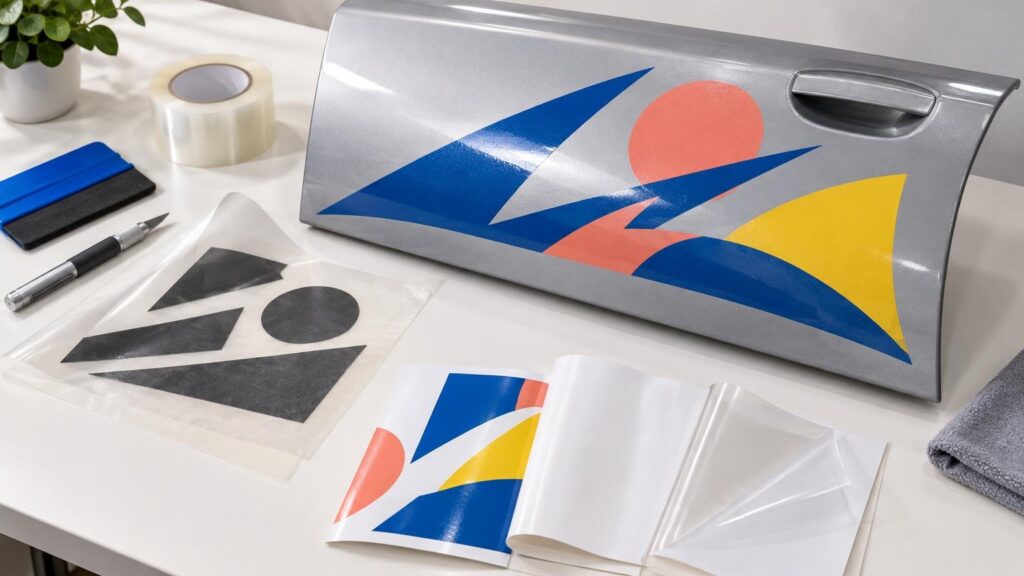
A cut transfer decal is usually the better construction for solid-color lettering, numbers, or a simple logo. The plotter cuts the design from colored vinyl, unwanted material is weeded away, and transfer tape keeps the remaining elements aligned during installation. After application, the vehicle surface shows between the letters.
This construction works well for business names, web addresses, unit numbers, and uncomplicated marks. Very thin strokes, tiny counters inside letters, and closely spaced details can be difficult to cut, weed, transfer, and install. Simplifying the design often improves both production reliability and readability.
A printed decal is preferable for photographs, gradients, shadows, textures, or artwork containing many colors. The image is printed on a compatible vinyl and then cut to its outer contour. A white film provides a consistent base for color, while clear material allows the vehicle color to influence transparent or unprinted areas. See the practical differences in the comparison of transfer and clear stickers.
Choose the adhesive and laminate as part of the system
“Permanent” and “removable” are not complete buying specifications. Explain the intended surface, how long the graphic should remain installed, whether clean removal is important, and whether the vehicle has unusual coatings or surface conditions. Fresh paint, damaged paint, wax, ceramic coatings, textured plastic, and repainted panels can change adhesion or removal risk.
Full-color vehicle graphics often use an overlaminate or another manufacturer-approved protective construction, but a laminate should not be treated as a universal add-on. It must be compatible with the printable film, ink or printing process, contour demands, and intended exposure. 3M’s documentation emphasizes that final performance depends on the complete system and conditions, including material combinations, substrate preparation, installation, environmental exposure, curing or drying, and maintenance.
Choose gloss, matte, or another appearance only after resolving those functional requirements. Gloss can produce a vivid, polished appearance, while matte can reduce reflections and create a subdued finish. Either can be the wrong choice if it is not part of a compatible vehicle-graphic construction.
Prepare artwork for the physical decal
For lettering and clean logos, vector artwork is often the most useful starting point because shapes can be scaled and converted into cut paths without relying on a fixed pixel grid. Printing Ray’s custom-sticker guidance likewise identifies vector files as a strong option for logos and clean designs.
Detailed full-color artwork may contain raster images, but those images must have enough effective resolution at the final installed size. Enlarging a small web image can expose softness, compression artifacts, or jagged edges. Ask the selected printer for its current requirements rather than assuming a universal resolution, bleed, color mode, or file format.
Review the design at its actual output dimensions. A line that looks bold on a laptop can become fragile when cut at vehicle-door size, while a long web address may become unreadable from traffic distance. Check the following before approving production:
- Final width and height, measured against the intended panel
- Readability of the smallest text at a realistic viewing distance
- Whether thin lines, small counters, or isolated pieces can be cut and installed reliably
- The decal’s background construction: white, clear, contour-cut, or separate transfer elements
- Placement of the cut line around printed artwork
- Whether door handles, trim, panel gaps, or body lines interrupt important content
- Color expectations, especially when clear material or vehicle paint can affect appearance
- Separate versions for opposite sides if the artwork has directional elements
A digital proof is the right place to catch wrong sizing, unexpected borders, misplaced cut lines, or an unsuitable construction before production. Printing Ray presents proofing as a way to identify sizing and presentation problems, but buyers still need to inspect the proof carefully. Review the proofing policy and approval responsibilities before treating approval as a routine click.
Surface preparation and installation conditions matter
Even an appropriate film can fail to perform as expected if it is applied over contamination, moisture, or wax. The official 3M vehicle application bulletin identifies surface preparation, contamination, moisture, wax, and installation temperature as factors affecting adhesion. It gives a general application range of 60–90°F (16–32°C) for both the air and vehicle surface, while noting that individual products may have their own requirements.
Use the exact film manufacturer’s instructions rather than treating that range as universal. Confirm the approved cleaning method, minimum application temperature, post-heating requirements, edge treatment, and any waiting period after printing or lamination. If the graphic enters recessed areas or spans multiple panels, professional installation may be more economical than replacing a poorly applied graphic.
Window decals require an additional check. Visibility and windshield restrictions vary by jurisdiction and placement, so verify the applicable local and state rules before ordering. A material being physically suitable for glass does not establish that a particular location on the vehicle is legal.
Questions to ask before ordering
- Is this exact film approved for the vehicle surface and contour complexity I described?
- Is it cast or calendered, and why is that category appropriate for this job?
- Is the graphic cut from solid-color vinyl or printed and contour cut?
- What adhesive behavior and planned removal period does the product support?
- Does the printed construction use a compatible laminate or protective system?
- Are there restrictions involving wax, ceramic coatings, fresh paint, repainted panels, textured plastic, or damaged finishes?
- What artwork changes are needed for fine lines, small text, separate pieces, or cut paths?
- Will I receive a proof showing final dimensions, material, background, and cut shape?
- What temperature, cleaning, curing, and installation instructions apply to the selected product?
- What warranty or remedy applies to the complete printed and installed system?
If you are ready to price a custom graphic, you can submit the project to a custom sticker and decal printer. Include photographs and measurements of the installation area rather than sending artwork alone. The more clearly the provider understands the surface and contours, the better it can assess whether a simple decal film or a specialized vehicle-graphic system is appropriate.
Common questions about car decal materials
What type of vinyl is best for a car decal?
For demanding curves and wrap-style applications, start with a cast vehicle-film system. For a smaller graphic on a flat or gently curved area, a suitably rated calendered film may work. The correct answer also depends on adhesive needs, expected removal, printing method, protective layer, and the exact vehicle surface.
Do all outdoor car decals need laminate?
Not every cut or printed product uses the same construction. Solid-color cut vinyl and full-color printed vinyl have different production needs. For printed graphics, ask whether the manufacturer specifies a matched overlaminate or another protective construction for the intended exposure. Do not add an arbitrary laminate without checking compatibility.
Can a decal be applied over wax or ceramic coating?
Do not assume so. Surface treatments can alter adhesion, and manufacturer instructions may require particular cleaning or preparation. Tell the printer and installer about coatings before choosing the film, and test when the product documentation recommends it.
The practical choice
Choose the decal construction from the vehicle outward. Identify the surface and contours, define the display and removal period, decide between cut lettering and full-color print, and then confirm a compatible film, adhesive, laminate, and installation method. For a flat temporary graphic, that may be a straightforward calendered product. For channels, compound curves, or wrap-style coverage, investigate a complete cast vehicle-film system. Finally, approve the material and artwork details in writing before production begins.