TLDR
Do stickers stick to silicone? Sometimes they appear to at first, but ordinary stickers and labels are often unreliable on bare silicone. Silicone has very low surface energy, which makes it difficult for many pressure-sensitive adhesives to spread across the surface and form a durable bond. For anything that must survive flexing, washing, heat, moisture, or regular handling, use an adhesive construction specifically identified as compatible with silicone and test it on the finished item.
Cleaning the surface and applying firm pressure can improve contact, but preparation cannot turn an incompatible adhesive into a compatible one. Also remember that “vinyl sticker” describes the printable face material, not necessarily the adhesive underneath. Vinyl alone does not guarantee that a sticker will stay attached to silicone.
Why stickers have trouble sticking to silicone
A pressure-sensitive sticker works when its adhesive makes close contact with the application surface. This spreading and contact process is commonly called wet-out. Silicone is a very-low-surface-energy material, so many general-purpose adhesives resist spreading across it. The sticker may touch the surface without developing enough contact for a strong, lasting bond.
That explains the familiar pattern: a sticker seems secure when first pressed down, but its corners begin lifting later. Once an edge rises, handling, friction, moisture, and movement can work underneath the label and accelerate peeling.
The word “silicone” can also cover significantly different surfaces. A rigid item with a thin silicone treatment is not the same application as a soft silicone phone case, flexible wristband, coated fabric, or textured kitchen product. Surface finish, additives, manufacturing residues, flexibility, and exposure conditions can all change the outcome. A label that works on one silicone formulation should not automatically be assumed to work on another.
Do regular paper or vinyl stickers work on silicone?
A regular paper sticker may cling temporarily, especially on a clean, smooth, flat area that is rarely handled. It is still a poor choice when dependable adhesion matters. Paper can also absorb moisture or tear, creating another failure point even if the adhesive initially holds.
Vinyl is generally more resistant to handling and moisture than ordinary paper, but that addresses the sticker face rather than the silicone-bonding problem. A vinyl facestock can still be paired with a general-purpose adhesive that performs poorly on silicone. PrintingRay’s general custom- and vinyl-sticker pages do not specify a silicone-compatible adhesive chemistry, so those product descriptions should not be treated as proof of silicone adhesion.
This distinction matters when comparing vinyl, BOPP, and paper sticker materials. Facestock affects appearance, conformability, moisture resistance, and print performance. Adhesive chemistry determines whether the construction can bond to the intended surface. Both must suit the application.
| Sticker or label type | Likely issue on silicone | Practical decision |
|---|---|---|
| General-purpose paper sticker | Adhesive may lift, while the paper can also absorb moisture or tear | Use only for a short, noncritical test |
| Standard vinyl sticker | Durable face material does not guarantee a silicone-compatible adhesive | Ask for the adhesive specification rather than relying on the word “vinyl” |
| Water-resistant or laminated sticker | Protected print may survive water while the adhesive still releases from silicone | Evaluate water resistance and surface adhesion separately |
| Silicone-compatible label construction | Designed around a difficult substrate, but performance still depends on the exact surface and conditions | Request samples and test them on the production item |
What kind of sticker has the best chance of working?
Look for a complete pressure-sensitive label construction that the manufacturer or converter identifies for silicone or silicone-treated surfaces. Do not choose only by facestock or finish. The release liner, adhesive coat, printable face, top coating, and any laminate have to work together.
Adhesive manufacturers distinguish between different pressure-sensitive adhesive chemistries and their bonding tradeoffs. 3M specifically describes silicone adhesive tape systems as suitable for bonding silicone materials. Its overview of pressure-sensitive adhesive chemistries is useful for understanding why a tape or label needs more than a generic “permanent adhesive” description.
Specialty label portfolios also include constructions intended for difficult substrates, including silicone or silicone-treated surfaces. This supports a practical rule: silicone labeling depends on selecting the right adhesive, not merely choosing a thicker or more weather-resistant sticker.
When requesting custom stickers for a silicone item, provide the supplier with the exact substrate and operating conditions. Ask whether the proposed adhesive is explicitly rated or recommended for that silicone surface. If the answer is based only on the sticker being vinyl, waterproof, laminated, or “permanent,” request more specific technical information or a sample.
How to apply a compatible sticker to silicone
Correct application gives a suitable adhesive its best opportunity to bond. It does not rescue the wrong adhesive, but it can prevent contamination, trapped air, and incomplete contact from undermining an otherwise workable label.
- Confirm compatibility first. Check the adhesive manufacturer’s data or obtain a recommendation based on the specific silicone formulation and use conditions.
- Test the cleaner in a hidden area. The cleaning method must remove dust, oils, and residue without swelling, staining, softening, or otherwise damaging the silicone.
- Let the surface dry completely. Moisture or cleaner trapped under the label can interfere with contact.
- Avoid touching the adhesive. Finger oils and dust can contaminate it before application.
- Apply the sticker smoothly. Start at one edge and press across the label to reduce trapped air and wrinkles.
- Use firm, even pressure over the entire label, especially around its perimeter. Proper pressure helps a pressure-sensitive adhesive establish contact with the surface.
- Leave the sample undisturbed for the adhesive manufacturer’s specified dwell period before judging the result or exposing it to demanding conditions.
- Test under real use. Flex, wash, heat, cool, rub, or handle the labeled item as it will be treated after production.
Conditions that make peeling more likely
Silicone is already challenging, and several design or use conditions make adhesion more difficult. Flexible objects repeatedly put the label under peel and shear stress. A sticker on a squeeze grip, wristband, phone case, or collapsible container must move differently from the silicone beneath it, which can cause the edges to lift.
- A textured or heavily curved application area that reduces full adhesive contact
- A label that crosses a seam, ridge, recess, or sharp change in curvature
- Frequent bending, squeezing, twisting, or stretching
- Skin oils, lotions, dust, or manufacturing residue on the surface
- Washing, immersion, condensation, or repeated wet-and-dry cycles
- Heat, cold, sunlight, or rapid temperature changes outside the adhesive’s specified range
- Friction from pockets, bags, hands, equipment, or nearby parts
- A large, stiff label applied to a small or highly flexible item
- Sharp sticker corners, which offer convenient starting points for lifting
A smaller label with rounded corners may conform better and expose less edge to friction, but geometry cannot solve chemical incompatibility. Treat shape and size as supporting choices after selecting an appropriate adhesive.
How to test a silicone label before a production order
For commercial labeling, a sample test is more useful than a general promise that a sticker is permanent. Give the label supplier an unused production item rather than a description alone whenever possible. The supplier should know whether the surface is bare silicone, coated, textured, soft-touch, flexible, curved, or exposed to possible mold-release residue.
Define failure in practical terms. A decorative event sticker needed for one day has a different requirement from a serial-number label expected to remain legible through repeated cleaning. State the required life, whether removal is acceptable, and whether residue matters.
- Apply multiple samples to representative items from the actual production batch.
- Include the smallest curve, roughest texture, and most frequently handled location under consideration.
- Follow the supplier’s application instructions, including cleaning, pressure, and dwell time.
- Inspect for edge lift, bubbles, sliding, adhesive transfer, print damage, and loss of legibility.
- Repeat the expected environmental cycle rather than testing only at room conditions.
- Record the label construction and adhesive code so a successful sample can be reordered accurately.
Testing is particularly important when a label carries a barcode, safety message, asset number, or required product information. A visually attractive sticker is not successful if it peels before the information has served its purpose.
Common questions about stickers on silicone
Why do stickers peel off silicone?
Many sticker adhesives cannot wet out sufficiently on silicone’s low-energy surface. Contamination, texture, flexing, curves, friction, and environmental exposure can make the weak bond fail even faster.
Do waterproof stickers work on silicone?
Not necessarily. “Waterproof” or “water-resistant” usually describes the printed face, coating, or overall resistance to moisture. It does not prove that the adhesive bonds to silicone. A waterproof sticker can remain perfectly readable while peeling away intact.
Can I put a sticker on a silicone phone case?
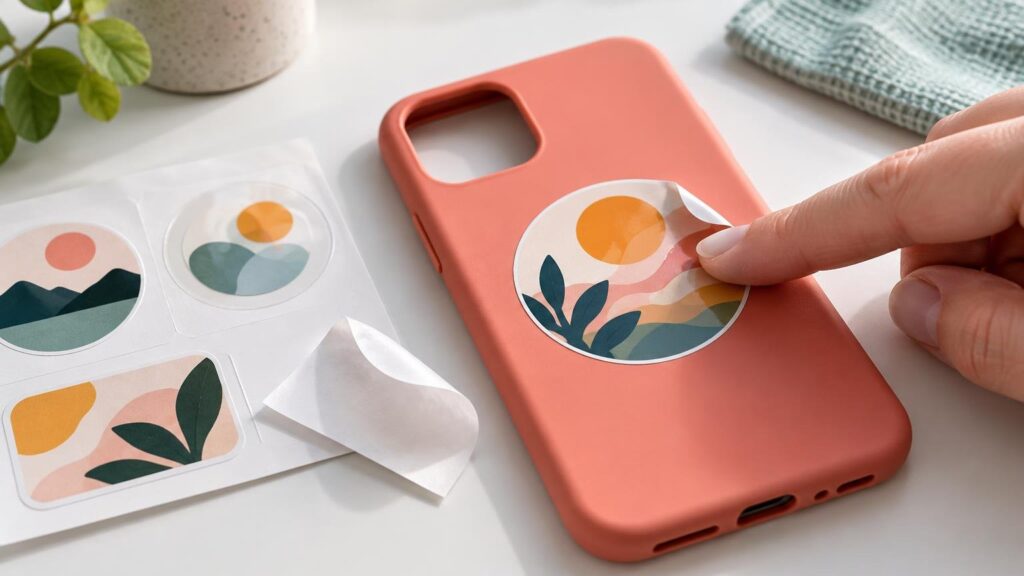
You can try, but a general-purpose sticker is likely to be temporary. Phone cases are flexible, curved, frequently handled, exposed to skin oils, and rubbed against pockets or bags. Use a silicone-compatible adhesive if the decoration must last, or choose a decoration method designed as part of the case rather than relying on a standard sticker.
Does double-sided tape stick to silicone?
Some specialty double-sided tapes use adhesive systems intended for silicone, but ordinary double-sided tape can face the same low-surface-energy problem as a sticker. Verify that the tape is recommended for the exact silicone substrate and load. The word “strong” is not a substitute for compatibility.
Can silicone products be labeled reliably?
Yes, but reliable labeling requires an adhesive selected for the substrate, suitable label geometry, controlled application, and validation under real conditions. There is no universal sticker that can be assumed to work on every silicone formulation.
The practical answer
Ordinary stickers may cling to silicone for a while, but they should not be trusted for a critical or long-term application. Start with a silicone-compatible pressure-sensitive adhesive, then match the facestock and finish to the item’s flexibility, environment, and required label life. Clean and dry the surface, apply firm pressure, allow the specified dwell time, and test samples on the actual product. That process provides a far better answer than choosing a sticker simply because it is vinyl, laminated, or marketed as permanent.